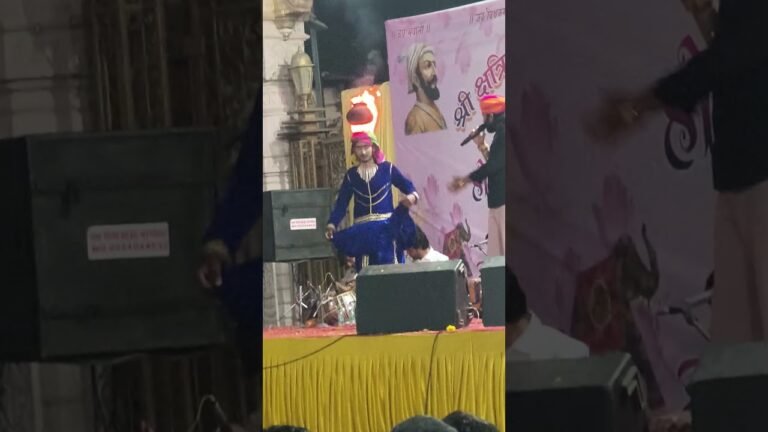
Sundarkand is the fifth book of the Ramcharitmanas composed by Goswami Tulsidas — the chapter devoted entirely to Hanuman’s valour, wisdom and devotion. For the Rajasthani samaj settled in Ahmedabad, Sundarkand is not merely a scripture but a collective ritual repeated every month. A society in Narol or a temple in Shahibaug — somewhere or the other, a Sundarkand path is always underway.
What is Sundarkand
The Ramcharitmanas is divided into seven kands — Balkand, Ayodhyakand, Aranyakand, Kishkindhakand, Sundarkand, Lankakand and Uttarkand. Sundarkand is the fifth of these.
It contains roughly 60 dohas and more than 500 chaupais, along with shlokas and sorthas. It is the only kand in the entire Ramcharitmanas whose centre is not Lord Ram himself but his devotee Hanuman.
Why is it called “Sundar”
Several explanations of the name are current. According to one, of the three peaks of Mount Trikuta on which Lanka stood, one was named “Sundar” — and since most of the events of this kand unfold there, it came to be called Sundarkand. Another holds that everything in this kand is beautiful — Hanuman’s mission is beautiful, Sita’s forbearance is beautiful, and the outcome, finally, is beautiful too.
The story of Sundarkand — in brief
The narrative begins where Hanuman prepares to leap across the ocean in search of Sita. Jamvant reminds him of the power he had forgotten — and this is the first and most important message of the kand: recognising your own strength.
On the journey ahead he passes Sursa’s test, humbles Lankini’s pride, meets Vibhishan, and at last finds Sita in the Ashok Vatika. Handing her Shri Ram’s ring, he steadies her resolve. Then follow the slaying of Akshay Kumar, his fearless words in Ravan’s court, and the burning of Lanka. The kand closes as he brings Shri Ram news of Sita.
The importance and benefits of Sundarkand Path
Devotees hold the recitation of Sundarkand to be especially fruitful. The reasoning offered is that this is the kand of success — in it Hanuman completes his mission and fails nowhere.
- Relief from fear and obstacles — reciting Sundarkand in times of difficulty is the most widespread practice of all.
- Growth in self-belief — the episode in which Jamvant reminds Hanuman of his own power is the core message.
- At the start of something new — a path is held at occasions such as a griha pravesh, the launch of a business or a marriage.
- Collective unity — neighbours and members of the samaj sit together to recite, and the social bond grows stronger.
How Sundarkand Path is performed
No elaborate ritual is required to recite Sundarkand. The method generally followed is this:
- Bathe, wear clean clothes and sit facing east or north.
- Light a lamp before a picture or idol of Hanuman. The custom is to use a jasmine-oil lamp and to offer sindoor.
- Begin with the Ganesh vandana and remembrance of Shri Ram, then start the path.
- Do not break the recitation midway — if a pause is unavoidable, take it after a doha.
- Close with the Hanuman aarti and distribute prasad. Boondi, gud-chana or laddu is the usual bhog.
Tuesdays and Saturdays are held to be particularly auspicious for the path. A complete recitation normally takes an hour and a half to two hours.
Musical Sundarkand — a tradition in transition
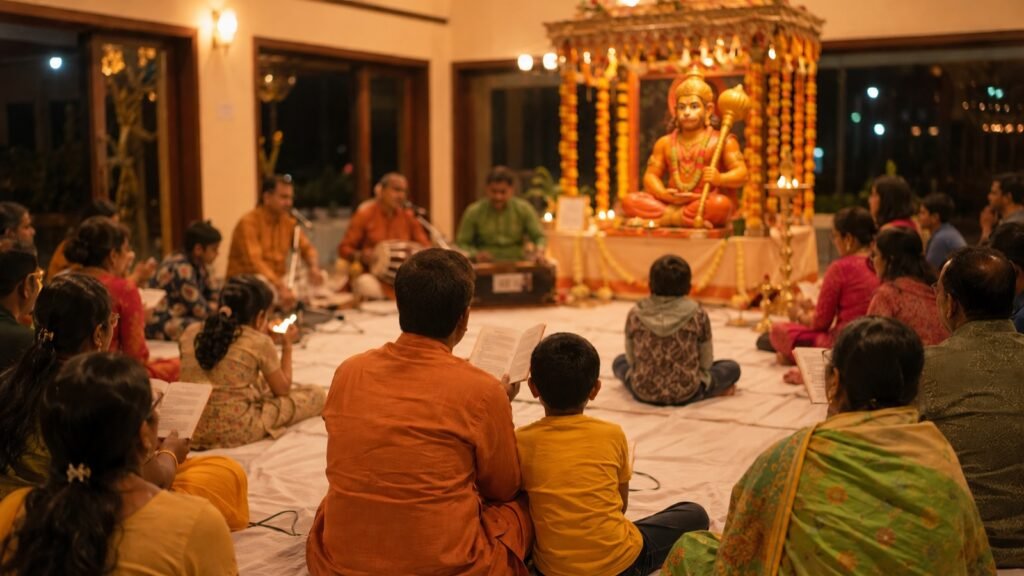
Over the past two decades the musical Sundarkand has spread rapidly. Here the chaupais are set to raga and rhythm and performed with the accompaniment of harmonium, dholak, tabla and manjira.
Its greatest practical advantage is that listeners stay engaged far longer than in a plain recitation. Children and young people, who hesitate to sit through a long path, join in effortlessly once there is a rhythm to follow. That is why almost every public programme in Ahmedabad now chooses the musical form.
In such programmes the vachak’s role is decisive. In Ahmedabad, mandals such as Shri Sundarkand Satsang Mandal (Isanpur), Shri Maruti Nandan Sundarkand Mandal and Shri Pavanputra Sundarkand Seva Mandal perform regularly.
The Sundarkand tradition in Ahmedabad
The migrant Rajasthani samaj settled in Ahmedabad has made Sundarkand a permanent part of its social life. Here the tradition appears mainly in four forms.
1. Monthly series
Some mandals have been holding a path on a fixed date every month for years. The series run by the Shri Mehandipur Balaji Mitra Mandal at the Rani Shakti Mandir in Shahibaug is an outstanding example, continuing unbroken through its 35th, 37th and 39th editions.
2. At a griha pravesh
Holding a Sundarkand when moving into a new home is the most widespread custom of all. The belief is that with Hanuman present, no negative force can enter the house. Karnavati-7 in New Narol, Empire Evoke in Isanpur, the Bhanvarsinh Rajpurohit family in Narol and Karnavati-7 in Vatva — all are examples of this same tradition.
3. On personal occasions
Turning private occasions such as birthdays and wedding anniversaries into collective devotional programmes is a distinctive mark of this samaj — as the Dudavat family in Thaltej did for their son’s birthday, and a family at Aryaman Flats in Narol did on their wedding anniversary.
4. Society and neighbourhood programmes
Programmes held in the shared compounds of residential societies have grown the fastest. Rainbow Heights, Pushkar Heights, Pushpakunj Society, Varahi Park and Shri Narayan Residency in Ranip are examples. In flat culture, where neighbours barely know one another, these programmes give the whole compound one occasion to sit together.
How to organise a Sundarkand programme
If you wish to hold a Sundarkand path at your home, society or temple, keep these practical points in mind:
- Date and time — 5 pm to 8 pm works best, as working families are free at that hour.
- Mandali — for a musical path, fix the date with the mandali at least two to three weeks in advance.
- Seating — daris, sheets and enough room for both women and men.
- Booklets — hand out Sundarkand booklets for the collective recitation so everyone can read along.
- The darbar — a picture of Hanuman, flowers, an akhand jyot and the bhog.
- Prasad — distributing prasad after the aarti is considered essential.
Frequently asked questions (FAQ)
Which kand of the Ramcharitmanas is Sundarkand? — It is the fifth, coming after Kishkindhakand and before Lankakand.
How many dohas and chaupais does Sundarkand have? — Roughly 60 dohas and more than 500 chaupais, along with shlokas and sorthas.
When should Sundarkand be recited? — Tuesdays and Saturdays are held to be especially auspicious. Beyond that, the custom is to hold a path on Hanuman Janmotsav, at a griha pravesh and at the start of any new venture.
How long does a full Sundarkand take? — At a normal pace, about an hour and a half to two hours. In the musical form it can run three to four hours.
Can women recite Sundarkand? — Yes. There is no restriction on the Sundarkand path, and at many programmes in Ahmedabad women lead in all three roles — reciting, compering and organising.
What is the difference between musical Sundarkand and a plain path? — In a plain path the chaupais are read straight through, while in the musical form they are performed in raga and rhythm with instruments, which keeps listeners engaged much longer.
Conclusion
For Ahmedabad’s migrant Rajasthani samaj, Sundarkand is a vehicle for both faith and social connection. It keeps families settled far from their roots tied to their tradition, and it also gives the people of a neighbourhood or society one occasion each month to sit together. That togetherness is the real strength of this tradition.